
* selected projects
Collective response of bacteria under stress
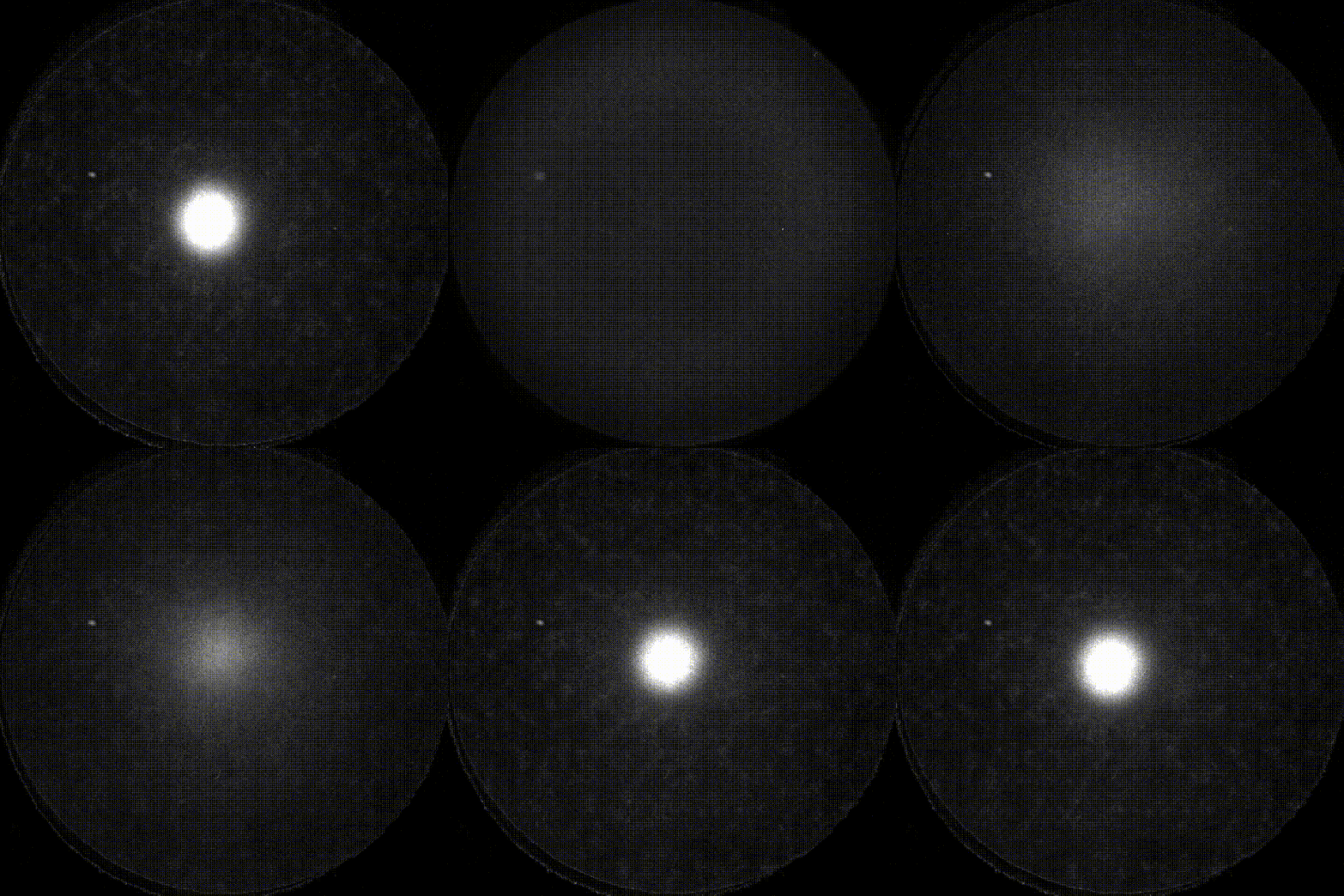
Individual bacteria can migrate towards nutrients and away from toxins. While migration can be a behavior of individual cells, collective behaviors can also emerge if bacteria modulate their chemical environment in ways that other bacteria sense. For instance, bacteria can secrete communication signals to attract other bacteria. In a recent project, we saw that bacteria coordinate their behaviors in order to deal with stress – when exposed to stress, cells can spontaneously pack together to provide comfort and safety for each other.
“Active turbulence” limits cell accumulation
Cells can generate chemical gradients to attract others, creating a positive feedback loop: as cells condense, the attraction signal strengthens, drawing in more cells (for example, see the project above). Theoretically, this should cause the local cell density to diverge; yet, in real life the system remains stable. We discovered that this condensation is limited by the emergence of ‘active turbulence’ – a form of collective bacterial swimming.


Bacterial response to conflicting chemical signals
When the bacteria E. coli are exposed to a source of nutrients, they tend to migrate towards it. Conversely, when bacteria are exposed to harmful substances, they tend to migrate away from the chemical source. My master’s thesis is about what happens when a population of cells is a exposed to a source that contains both nutrients and harmful substances emanating from the same point in space – how do bacteria solve this dilemma?
An experimental study of the mechanism behind the motion of ‘walkers’
A droplet of liquid may bounce indefinitely on a vertically vibrating bath of the same liquid. If the vibration is close enough to the bath’s Faraday instability threshold, the droplet can become a ‘walker’, and begin to propagate in a constant velocity. This happens because of a coupling between the bouncing droplet and the waves it creates on the liquid surface. As a part of an advanced physics lab course, we studied the mechanism behind this behavior.

 Nir Livne